What we do
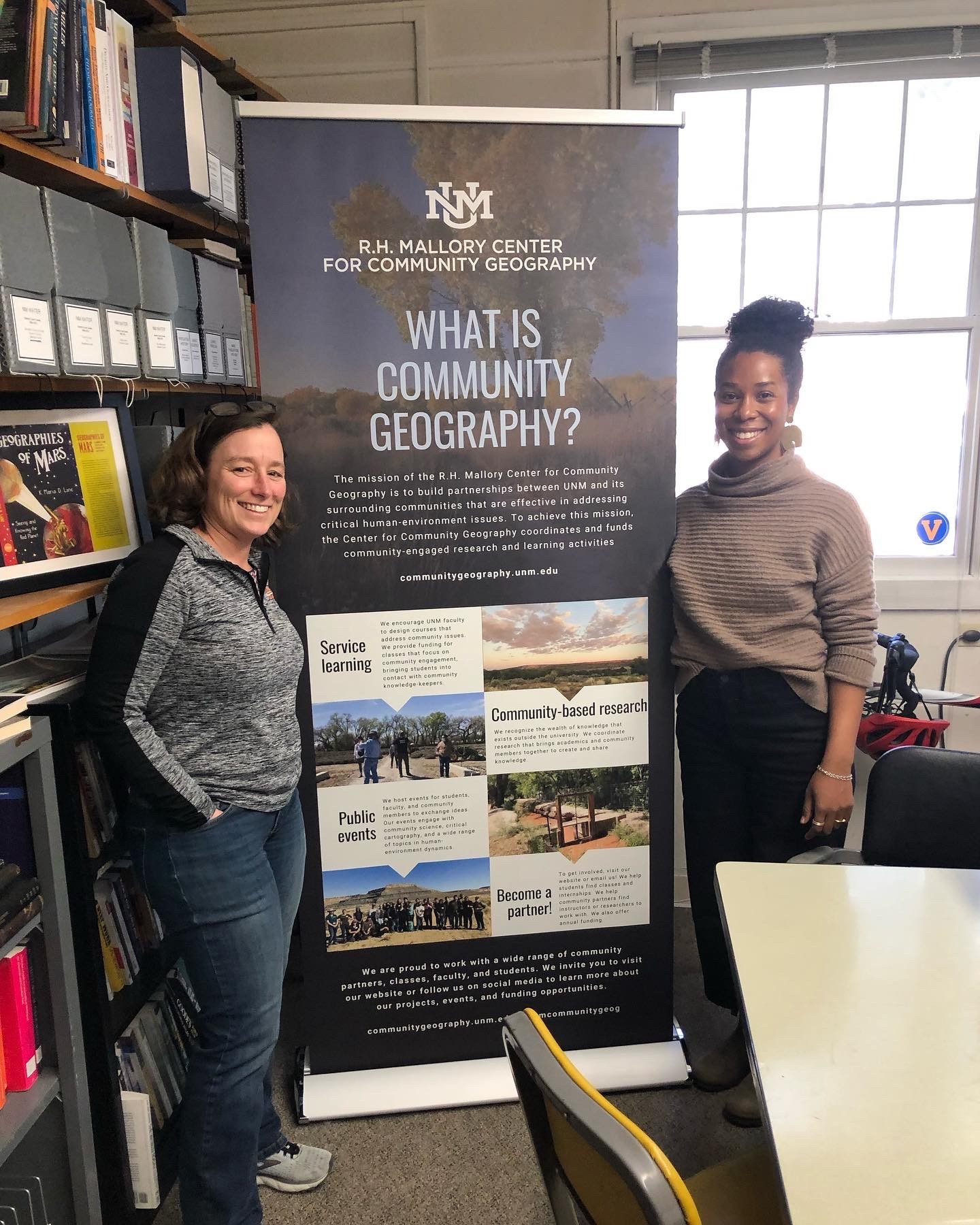 The mission of the Mallory Center for Community Geography is to build partnerships between UNM and its surrounding communities that are effective in addressing critical human-environment issues. To achieve this mission, the Center will coordinate and fund community-engaged research and learning activities using the following conceptual focus:
Conceptual Focus
The intellectual ground beneath the Center’s programs — five interlocking subfields that define how UNM scholars and community partners work together on human-environment dynamics.
Geography and Environmental Studies (GES) has long combined strength in human-environment research and teaching with field-based, mixed-methods training, and the Center exists to channel that strength into sustained partnership with the surrounding community. Rather than adopting a single disciplinary lens, the Center draws on five complementary subfields of geography, each offering a distinct way of putting university expertise in service of community-defined priorities. Together, they give the Center’s programs — fellowships, internships, grant partnerships, and public events alike — a shared intellectual foundation.
Community Geography
This subfield treats the spatial knowledge that residents build through lived, local experience as a legitimate and valuable form of expertise in its own right. Working through participatory methods, community geography grounds university research in genuine partnership: UNM researchers contribute tools, training, and technical capacity, while community members direct the questions and goals, so that the resulting work serves real, locally defined change.
Critical Physical Geography
Critical physical geography starts from the premise that physical landscapes and social systems are deeply entangled, and it pushes researchers toward methods that can analyze both together rather than in isolation. It asks scholars to be transparent about their own position within the research process and to treat that openness as part of producing more rigorous, more honest knowledge, in service of positive social and environmental change.
Citizen Science
Citizen science opens the research process itself to non-experts and community members, expanding both who gets to ask questions and what scale of data can realistically be gathered. By widening participation, it builds public understanding of how knowledge gets produced and lets community members steer research questions toward the issues that matter most to them, a natural complement to the Center’s fellowship and internship programs.
Critical Cartography
Critical cartography holds that conventional maps, however neutral they may appear, often encode and reinforce existing power imbalances. It calls for “counter-mapping” practices that pursue social and economic justice instead, and it invites university researchers to partner with local communities on participatory or experimental mapping that foregrounds local knowledge and everyday experience over formal, top-down representation.
Sustainability
Sustainability is central to the Center’s work, treating environmental, social, and economic well-being as interdependent rather than competing goals. It asks how present-day decisions about land, water, food, and energy affect the resources and resilience available to future generations, and it grounds that question in New Mexico’s own resource constraints: water scarcity, food access, and climate adaptation chief among them. As a focus area, sustainability links naturally to the Center’s partnership with the Sustainability Studies Program within GES and gives community-engaged research and curriculum a shared standard for measuring long-term impact, not just immediate output.